Retaining Wall Calculator
Blocks, caps, base and drainage stone, and drain pipe for a segmental retaining wall, plus the dig and the delivery.
Quick answer
A 30 ft wall standing 2 ft tall in 8 x 18 in block takes 4 courses (one buried) of 20: 84 blocks with 5 percent extra, 20 caps, and about 4.9 tons of clean crushed stone for the base and the 12 in behind the block. The blocks alone weigh about 6,400 lb.
Measure the wall
Along the face
The buried course is added
Block
From your supplier
Cuts and chips
Also needed on wet or clay sites
84 blocks and 4.9 tons of stone.
For a 30 ft wall, 2 ft above ground
84blocks
4.9tons of stone
1.8pallets
4 courses (1 buried) of 20 · 20 caps · about 16,300 lb
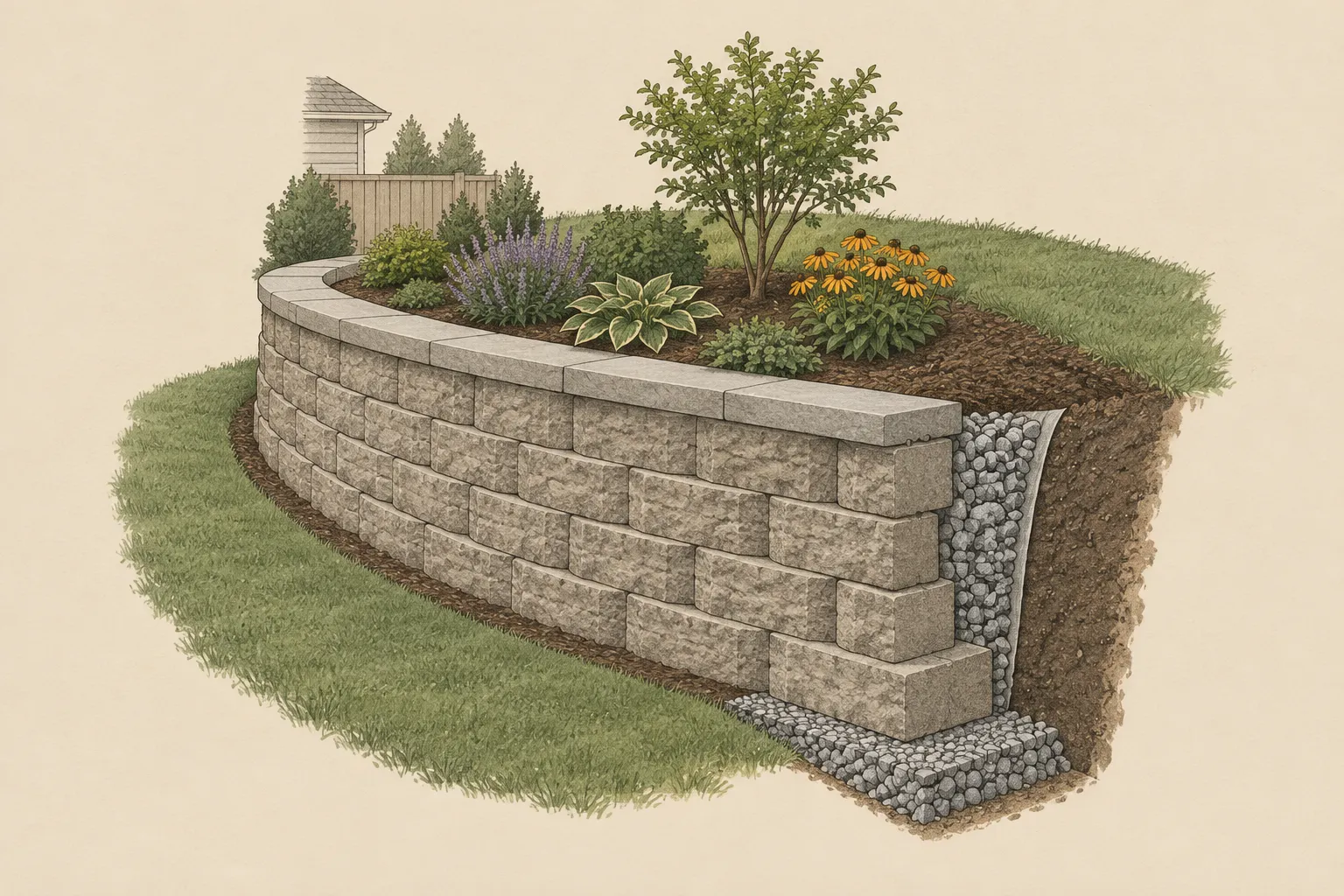
The wall is 32 in of block from the base up: 3 courses show and 1 sits below grade. Stone fills a 18 x 4 in base and 12 in behind the block, per the Allan Block guide.
HaulOnce order ticket
Retaining wall
Ticket no.
562519
Example price, enter yours
Example price
Example price
Example price
Materials only. Filter fabric, adhesive, delivery, and a plate compactor rental are extra.
Estimate from haulonce.com. Weights vary with moisture and supplier. Prices are examples unless you entered your own.
The dirt you dig out
The base trench is 18 in wide and 12 in deep: 1.7 cu yd in the ground, about 2.1 cu yd once it is dug and fluffed up, weighing 3,300 to 4,500 lb. Most of it can go back as backfill behind the stone. Cutting into a slope digs out more.
A few pickup loads, or offer it free online as clean fill. Soil is heavy, so check payload before loading.
Haul Check
Typical 1,150 to 2,400 lb. We use the low end until you enter yours.
Check the Tire and Loading Information sticker on your driver's door jamb for your exact payload.
That is 15,128 lb over your payload. Plan on 15 trips of about 1,085 lb.
At this many trips, ask the yard what delivery costs. It is often less than your time and fuel.
Using the low end of the typical payload range. Enter your own for an exact answer.
What pros know
- The base makes the wall. Dig the trench, compact the soil, then lay and compact at least 6 in of crushed stone before the first block. Source
- Bury the first course, plus about 1 in for every foot of wall height. Source
- Fill 12 in behind the block with clean crushed stone so water drains instead of pushing on the wall. Source
- Over 4 ft tall, a retaining wall usually needs an engineer, and often a permit. Check with your town first. Source
Pricing the stone on its own? The #57 stone calculator does bags or bulk and truck trips.
Ready to text or email your supplier:
“Retaining wall: 84 wall blocks (8 x 18 in face), 20 caps, 4 cu yd of 3/4 in clean crushed stone.”
How many retaining wall blocks do I need?
Count courses, then blocks per course. Divide the height above ground by the block height and round up, then add the buried course: at least one full course goes below grade, plus about 1 in for every foot of wall height (Allan Block). Divide the wall length by the block's face length for the blocks in each course, and multiply.
Per square foot of face, a 4 x 12 in block works out to about 3.1 blocks and an 8 x 18 in block to 1. Caps run the length of the top course.
| Height above ground | 10 ft long | 20 ft long | 30 ft long | 50 ft long |
|---|---|---|---|---|
| 1 ft | 23 | 45 | 63 | 108 |
| 2 ft | 30 | 59 | 84 | 143 |
| 3 ft | 45 | 89 | 126 | 215 |
| 4 ft | 52 | 103 | 147 | 250 |
| Height above ground | 10 ft long | 20 ft long | 30 ft long | 50 ft long |
|---|---|---|---|---|
| 1 ft | 47 | 89 | 131 | 219 |
| 2 ft | 81 | 155 | 228 | 383 |
| 3 ft | 116 | 221 | 326 | 546 |
| 4 ft | 151 | 287 | 424 | 710 |
Base, drainage stone, and drain pipe
Allan Block's install guide digs a trench 24 in wide with 6 in of compacted wall rock (clean crushed stone) under the first course; for walls under 4 ft, 18 in wide and 4 in deep. Add the buried block to the trench depth.
Behind the block, fill 12 in with the same stone for the full height, so water drains down instead of pushing on the wall. A 4 in perforated drain pipe at the back of the base is required for walls over 4 ft and on poorly drained ground, with an outlet to daylight at least every 50 ft. The calculator totals the stone in cubic yards and tons; the #57 stone calculator compares bags and bulk.
How tall can a block wall be without an engineer?
The IRC calls for an engineered design when a retaining wall holds back more than 48 in of soil without support at the top, and many towns want a permit at a lower height, especially near property lines, driveways, or slopes. Block makers publish their own maximum heights for each block without geogrid, often lower for small garden blocks. Check both before you build, and call 811 before you dig.
What a retaining wall costs
Enter your block, cap, stone, and pipe prices for the materials total and a cost per square foot of wall face. The defaults are examples only. Installed prices add excavation, compaction equipment, delivery, and labor, so a contractor's quote will be well above the materials.
Getting it home
Wall block is about the heaviest thing a homeowner buys. An 8 x 18 in block runs about 76.5 lb, so a half-ton's 1,150 lb payload carries only 15 of them, and a pallet of 48 is about 3,700 lb. Add the stone and most walls are a delivery: ask for the pallets dropped close to the wall, since you will move every block by hand.
What pros know
- The base makes the wall. Dig the trench, compact the soil, then lay and compact at least 6 in of crushed stone before the first block. (Allan Block)
- Bury the first course, plus about 1 in for every foot of wall height. (Allan Block)
- Fill 12 in behind the block with clean crushed stone so water drains instead of pushing on the wall. (Allan Block)
- Over 4 ft tall, a retaining wall usually needs an engineer, and often a permit. Check with your town first. (International Code Council)
Common mistakes
- Setting the first course on soil or sand instead of compacted crushed stone.
- Forgetting the buried course, which leaves the wall a block short.
- Backfilling with dirt right against the block instead of drainage stone.
- Building taller than the block's limit without geogrid or an engineer.
- Not leaving an outlet for the drain pipe, so it fills and does nothing.
Questions people ask
How many retaining wall blocks do I need?
Courses (height divided by block height, plus one buried) times blocks per course (length divided by block length). A 30 ft wall 2 ft tall in 8 x 18 in block is 4 x 20 = 80, or 84 with 5 percent extra.
How much gravel do I need behind a retaining wall?
Allan Block fills 12 in behind the block with clean crushed stone for the full height, plus the base. For a 30 ft wall 2 ft tall, about 3.5 cu yd (4.9 tons) in all.
How deep should a retaining wall base be?
At least 6 in of compacted crushed stone in a 24 in wide trench (4 in and 18 in wide for walls under 4 ft), plus the depth of the buried course.
How tall can a retaining wall be without a permit?
The IRC requires an engineered design past 48 in of retained soil, and many towns require a permit lower than that. Check with your building department.
How many retaining wall blocks are on a pallet?
It depends on the size: one retail listing puts 144 small 4 x 12 in blocks on a pallet, and one producer ships 48 of the 8 x 18 in size.
Sources
- Allan Block, Basic Installation (residential): base trench width and depth, 1 in of extra depth per ft of wall height for buried block, 12 in of wall rock behind the block, drain pipe
- Nitterhouse Masonry (Allan Block producer), AB Classic catalog page: 8 x 18 in face, about 1 sq ft, 76.5 lb, 48 per pallet
- Home Depot product listing, Pavestone RockWall Small 4 x 11.75 x 6.75 in retaining wall block: 144 pieces, 46.5 face sq ft per pallet
- Ernest Maier (block producer), FAQ on Block: nominal versus actual dimensions (8 x 8 x 16 is 7-5/8 x 7-5/8 x 15-5/8 in) and ASTM weight classes
- International Code Council, 2021 International Residential Code: R311.7 stairways, R404.4 retaining walls, R703.8.4 masonry veneer ties (free to read online; your local code may differ)
- The Engineering ToolBox, Dirt and Mud: Densities (dry, moist, and wet soils, sand, and gravel)
- Caterpillar, Earthwork Volumes Reference Tables (swell and load factors)
- NHTSA, Tires: the Tire and Loading Information placard on the driver's door jamb
Last reviewed: . How we calculate
Related calculators and projects
- #57 Stone CalculatorClean #57 stone for drainage and driveway layers.
- Paver Base CalculatorCompacted paver base for patios, walks, and driveways.
- Cinder Block CalculatorBlocks, mortar, and core fill for a wall, with pallets and truck trips.
- Fill Dirt CalculatorFill dirt for grading and holes, in yards, tons, and trips.
- Brick CalculatorBrick by size, mortar bags or cement and sand, cubes, and weight.
- Paver PatioPavers by pattern, base, sand, edging, and the dirt you dig out.