Paver Calculator
Pavers by pattern, base, sand, edging, and the dirt you dig out, as one bill of materials.
Quick answer
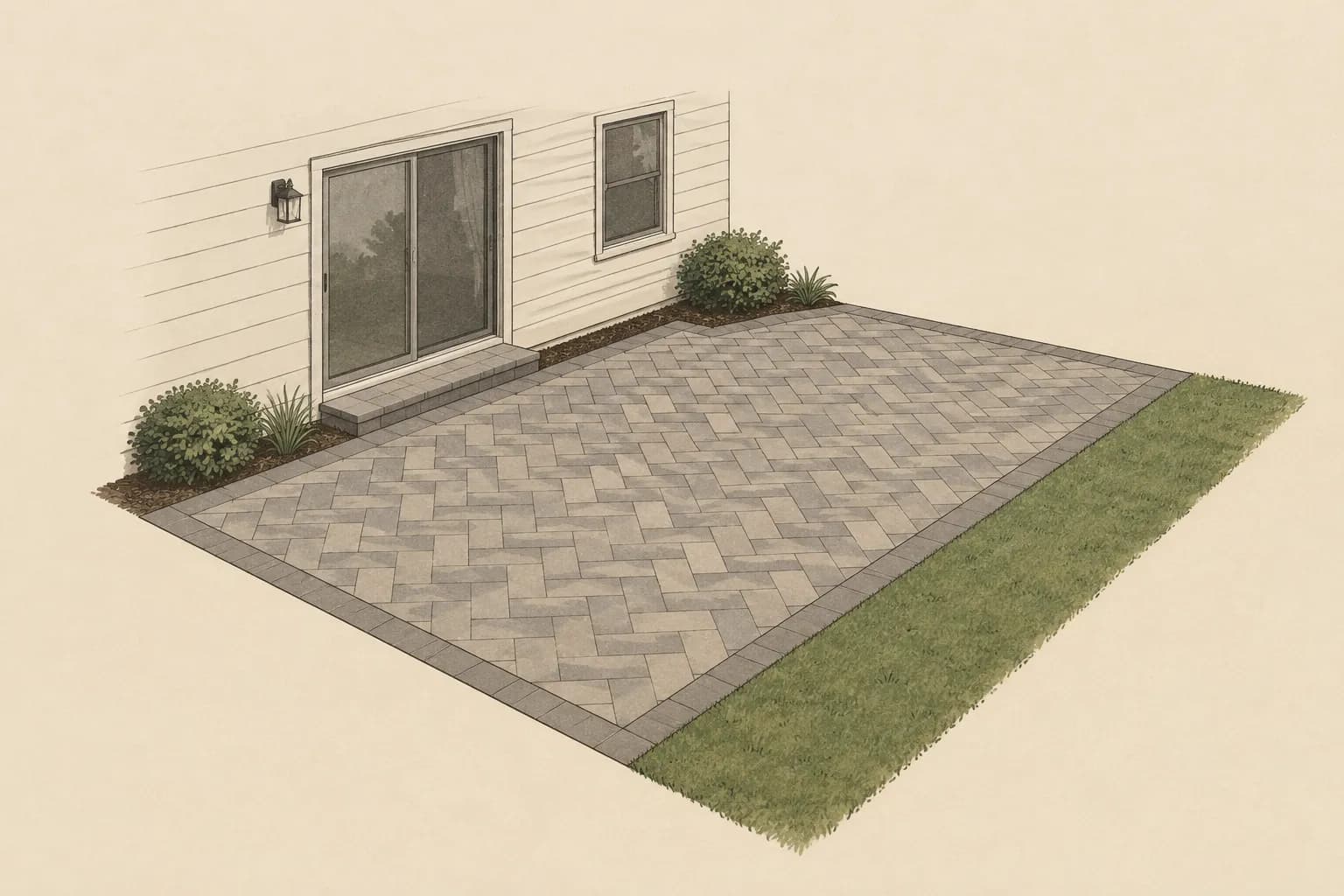
A 200 sq ft patio of 6 x 9 in pavers in running bond needs about 560 pavers with 5 percent for cuts, a 6 in compacted base, a 1 in sand bed, and 3 to 4 bags of polymeric sand. You also dig out about 7.2 cubic yards of loose soil.
Measure
Project details
4 to 6 in for a patio
No edge restraint needed there
Ask the yard; it varies by paver
Dug soil takes up about 25% more space (1.25). Clay can be 1.3 or more.
Adds local climate notes and goes into your copied order.
560 pavers. and 7.2 cu yd of dirt to dig out
Your project
560 pavers
and 7.2 cu yd of dirt to dig out
Measured: 200 sq ft, 60 ft of edge
HaulOnce order ticket
Paver patio
Ticket no.
989244
- 01Excavation (soil to remove)7.23 cu yd loose
Dig 9.38 in: 2.375 in paver + 1 in sand + 6 in base. 5.8 cu yd in the ground swells to about 7.2 loose.
Plan for a dumpster or a haul-away service. Soil is heavy: many haulers cap dirt by weight or require a dedicated clean-fill container, so tell them it is soil when you book.
- 02Paver base (compacted)4.67 cu yd
6 in deep over 200 sq ft
Order: 5 cu yd bulk (7.5 tons) or 252 bags of 0.5 cu ft. Weighs 13,070 lb to 14,930 lb.
Includes compaction (+20%), waste and uneven ground (+5%).
- 03Bedding sand (coarse concrete sand)0.65 cu yd
1 in screeded layer, not compacted
Order: 1 cu yd bulk (1.38 tons) or 35 bags of 0.5 cu ft. Weighs 1,690 lb to 1,880 lb.
Includes waste and uneven ground (+5%).
- 04Pavers, 6 x 9 in560 pavers
534 to cover the area + 5% for running bond cuts. About 2.1 pallets at 100 sq ft each.
- 05Polymeric sand, 50 lb bags4 bags
Narrow joints (1/8 to 3/8 in): 65 to 85 sq ft per bag, so 3 to 4 bags. Planned on the low coverage.
- 06Edge restraint8 pieces
8 ft pieces for 60 linear ft
- 07Edge spikes61 spikes
About one every 12 in
Before you start
- Slope the patio away from the house, about 1/4 in per foot, so water drains off.
- Compact the base in 2 to 3 in lifts. Do not compact the bedding sand before laying pavers.
- Call 811 before you dig to have utility lines marked. It is free.
Estimate from haulonce.com. Weights vary with moisture and supplier. Prices are examples unless you entered your own.
Haul Check
Typical 1,500 to 2,300 lb. We use the low end until you enter yours.
Check the Tire and Loading Information sticker on your driver's door jamb for your exact payload.
Paver base hits your payload long before your bed is full.
That is 12,500 lb over your payload. You need 10 trips.
Split it into 10 loads of about 0.47 cu yd (1,400 lb) each, or get it delivered instead. At this many trips, delivery usually costs less than your time and fuel.
Using the low end of the typical payload range. Enter your own for an exact answer.
Ready to text or email your supplier:
“I need 5 cubic yards of paver base (crushed) delivered.”
Add your ZIP code above to include it.
What goes under a paver patio
From the bottom up: compacted subgrade, a compacted base of crushed stone (4 to 6 in for patios, 8 to 12 in for driveways), a 1 in layer of bedding sand screeded smooth, the pavers, and polymeric sand in the joints. An edge restraint around the open sides keeps it all from spreading.
So you dig down the paver thickness plus the sand plus the base. That is where most first-timers get surprised: the hole for a 200 sq ft patio is over 5.8 cubic yards of soil, and once dug it swells about 25 percent to 7.2 yards. Plan where it goes before you start.
Waste by laying pattern
Some patterns need more cuts at the edges. The calculator adds extra pavers for the pattern you pick.
| Pattern | Extra for cuts |
|---|---|
| Running bond | 5% |
| Stack bond (grid) | 5% |
| Basketweave | 7% |
| Herringbone, 90 degree | 10% |
| Herringbone, 45 degree | 12.5% |
| Curved edges (any pattern) | +5% |
Paver sand, two kinds
Bedding sand is coarse concrete sand under the pavers: one cubic yard covers about 324 sq ft at 1 inch. Polymeric sand goes in the joints: a 50 lb bag covers roughly 65 to 85 sq ft with narrow joints, per one manufacturer. See the sand calculator and polymeric sand calculator for either one on its own.
How to measure
Measure the length and width in feet, multiply for square feet, then decide the depth in inches. For odd shapes, split the area into rectangles, circles, and triangles and add them up; the calculator lets you add as many areas as you need and subtract cut-outs like a tree ring or an air-conditioner pad.
No tape measure? Open the Draw on satellite map tab, find your address, and trace the outline. Or use Pace it off: count steps along each side. Measure depth in a few spots, because ground is rarely flat.
Mark how many feet of the patio edge run against the house or a wall. Those sides do not need edge restraint, and the calculator subtracts them.
Want the area on its own first? The lawn size calculator measures any part of your yard and carries it into the other calculators.
What pros know
- A patio usually needs 4 to 6 inches of compacted base; driveways need 8 to 12. Where the ground freezes deep, go to the high end. (Concrete Masonry and Hardscapes Association (formerly ICPI))
- A 6 in patio base over 200 sq ft is roughly 4.5 yards ordered, or about 250 bags. Bulk wins here almost every time. (Concrete Masonry and Hardscapes Association (formerly ICPI))
Common mistakes
- Forgetting the excavation and where the dirt goes.
- Compacting the bedding sand before laying pavers.
- Building a thin base on clay soil.
- Not sloping the patio away from the house.
- Skipping 811 before digging.
Questions people ask
How many pavers do I need?
Divide the patio area by the area of one paver, then add extra for cuts: about 5 percent for running bond, more for basketweave and herringbone. A 200 sq ft patio of 6 x 9 in pavers is about 534 pavers before waste.
How much paver base do I need?
Area x base depth in feet, divided by 27, plus about 20 percent for compaction. A 200 sq ft patio at 6 inches needs about 4.4 cubic yards.
How much sand do I need for pavers?
A 1 inch bedding layer: about 0.62 cubic yards for 200 sq ft. Joint sand is separate and sold by coverage per bag.
How deep do I dig for a paver patio?
Paver thickness plus 1 inch of sand plus the base. With 2 3/8 in pavers and a 6 in base, that is about 9.4 inches.
What do I do with the dirt from a patio dig?
Use some to regrade or fill low spots, offer it as free fill, or book a dumpster or haul-away. Tell the hauler it is soil; many limit dirt by weight.
How many pavers are on a pallet?
It varies by paver size and maker, often roughly 80 to 120 sq ft per pallet. Ask your supplier and enter it in the calculator.
Sources
- Concrete Masonry and Hardscapes Association (formerly ICPI), interlocking paver installation guidance
- Alliance Gator, Reference Guide 2025 (polymeric sand coverage by joint width)
- Caterpillar, Earthwork Volumes Reference Tables (swell and load factors)
- Trimble ProContractor documentation, Enter Swell and Yield Factors (25 percent swell example)
- The Engineering ToolBox, Dirt and Mud: Densities (dry, moist, and wet soils, sand, and gravel)
Last reviewed: . How we calculate
Related calculators and projects
- Paver Base CalculatorCompacted paver base for patios, walks, and driveways.
- Polymeric Sand CalculatorBags of joint sand from your patio size and joint width.
- Sand CalculatorSand for pavers, play areas, and leveling, in bags or bulk.
- Crusher Run CalculatorCrusher run with compaction already added to the order.
- Lawn Size CalculatorMeasure your yard on a satellite map or by pacing it off.
- Gravel PathFabric, base, and pea gravel or DG for a garden path.