Crusher Run Calculator
Crusher run in cubic yards and tons, with compaction already added so you end up at the depth you measured.
Quick answer
One cubic yard of crusher run covers about 108 sq ft at 3 in deep, or 81 sq ft at 4 in deep.
Measure
Depth
5% is typical
Crusher run has stone dust mixed in, so it packs down hard when compacted. Ordering about 20 percent more gets you the finished depth you measured.
Adds local climate notes and goes into your copied order.
1.17 cu yd of Crusher run. 63 bags or 1.5 cubic yards bulk.
You need
1.17cubic yards
= 32 cu ft of crusher run · about 1.81 tons
This material packs down when compacted, so you order about 20% more to end up with the depth you measured.
5% extra covers spills, low spots, and the material that stays in the truck or wheelbarrow.
HaulOnce order ticket
Crusher run (dense grade, with fines)
Ticket no.
390090
Option A: Bags
63 bags
0.5 cu ft bag (about 50 lb), about 57 lb each
Example price, enter yours
Option B: Bulk
Cheaper1.5 cu yd
Rounded up to the nearest 0.5 yd, about 2.33 tons.
Example, enter yours
0 if you pick up
Ask your yard; many have a delivery minimum.
Bulk is cheaper above 0.4 cu yd. Bulk saves you $210.50 on this job.
Bags mean lifting 63 bags (about 3,620 lb in total). Bulk means about 13 wheelbarrow trips at 2.5 cu ft a load.
Estimate from haulonce.com. Weights vary with moisture and supplier. Prices are examples unless you entered your own.
Haul Check
Typical 1,500 to 2,300 lb. We use the low end until you enter yours.
Check the Tire and Loading Information sticker on your driver's door jamb for your exact payload.
Crusher run hits your payload long before your bed is full.
That is 2,120 lb over your payload. You need 3 trips.
Split it into 3 loads of about 0.39 cu yd (1,210 lb) each, or get it delivered instead. At this many trips, delivery usually costs less than your time and fuel.
Using the low end of the typical payload range. Enter your own for an exact answer.
What pros know
- Crusher run compacts, so order about 20 percent more than the finished depth. This calculator adds it for you. Source
- It is among the heaviest landscape materials, often over 1.5 tons per yard. One yard can overload a half-ton pickup by itself. Source
- Names change by region: crush and run, CR6, 21A, DGA, quarry process. Ask your yard what they call it. Source
Ready to text or email your supplier:
“I need 1.5 cubic yards of crusher run (dense grade, with fines) delivered.”
Add your ZIP code above to include it.
What did you pay? (optional)
Why crusher run needs extra
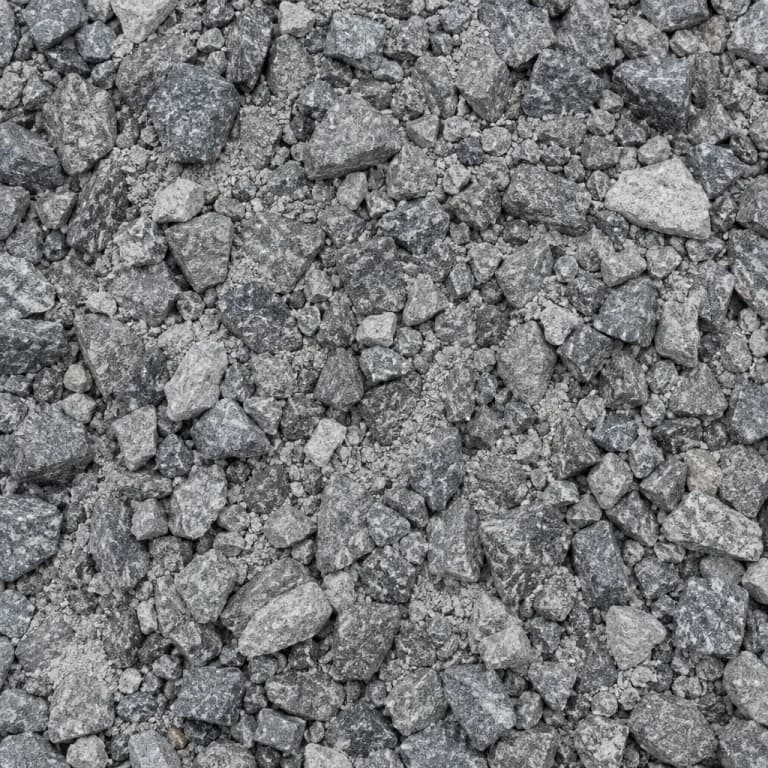
Crusher run (also called crush and run, CR6, 21A, DGA, or quarry process) is crushed stone mixed with stone dust. When you compact it, the dust fills the gaps and the layer gets denser and thinner. Measure the finished depth you want, and this calculator orders about 20 percent more to make up for it.
It is also one of the heaviest landscape materials. One yard can be more than a half-ton pickup should carry, so the Haul Check matters here.
How to measure
Measure the length and width in feet, multiply for square feet, then decide the depth in inches. For odd shapes, split the area into rectangles, circles, and triangles and add them up; the calculator lets you add as many areas as you need and subtract cut-outs like a tree ring or an air-conditioner pad.
No tape measure? Open the Draw on satellite map tab, find your address, and trace the outline. Or use Pace it off: count steps along each side. Measure depth in a few spots, because ground is rarely flat.
Want the area on its own first? The lawn size calculator measures any part of your yard and carries it into the other calculators.
Coverage by depth
One cubic yard covers about 108 sq ft at 3 in compacted, before the compaction allowance.
| Depth | 1 cu yd covers | 1 bag (0.5 cu ft) covers | Yards per 100 sq ft |
|---|---|---|---|
| 2 in | 162 sq ft | 3 sq ft | 0.62 |
| 3 in | 108 sq ft | 2 sq ft | 0.93 |
| 4 in | 81 sq ft | 1.5 sq ft | 1.23 |
| 6 in | 54 sq ft | 1 sq ft | 1.85 |
Crusher run has stone dust mixed in, so it packs down hard when compacted. Ordering about 20 percent more gets you the finished depth you measured. The calculator adds this for you; the table does not.
Weight per cubic yard
A cubic yard of crusher run weighs 2,800 to 3,400 lb (about 1.55 tons typical). Moisture is the big swing: the same pile weighs more after rain.
| Material | Low | Typical | High | Tons per yd |
|---|---|---|---|---|
| Crusher run (dense grade, with fines) | 2,800 | 3,100 | 3,400 | 1.55 |
Pounds per loose cubic yard, as delivered. Wet material sits at or above the high end.
See every material side by side on the material weights chart.
Bags versus bulk
It takes 54 bags of 0.5 cu ft to make one cubic yard, and each bag weighs about 60 lb. Bags cost more per yard but skip the delivery fee and the minimum order. Bulk is cheaper per yard once the delivery fee is spread over enough material.
With example prices of $6 a bag, $45 a yard in bulk, and $100 delivery, bulk starts winning at about 0.4 cubic yards. These are examples, not your local prices: type your own into the Order Ticket above and it recalculates the break-even.
Do not forget the labor. One cubic yard in bags means lifting 54 bags, about 3,100 lb in total, twice: into the cart and out of the car.
Hauling it yourself
One cubic yard of crusher run weighs about 3,100 lb. A full-size half-ton pickup typically carries 1,500 to 2,300 lb, and a midsize pickup 1,100 to 1,700 lb. Your exact number is on the Tire and Loading Information sticker on the driver's door jamb.
That means weight runs out first. At the low end of a half-ton's payload, you can carry only about 0.48 cubic yards per trip, even though a 6.5 ft bed holds about 2.1 level full. A bed that looks half empty can already be over the limit.
The Haul Check in the calculator does this math for your truck and your load, and tells you how many trips it takes.
What pros know
- Crusher run compacts, so order about 20 percent more than the finished depth. This calculator adds it for you. (Caterpillar)
- It is among the heaviest landscape materials, often over 1.5 tons per yard. One yard can overload a half-ton pickup by itself. (The Engineering ToolBox)
- Names change by region: crush and run, CR6, 21A, DGA, quarry process. Ask your yard what they call it. (Penn State Center for Dirt and Gravel Road Studies)
Common mistakes
- Ordering the finished depth without the compaction allowance.
- Compacting a thick layer in one pass. Work in 2 to 3 inch lifts.
- Using it where you need drainage. The fines slow water down.
Questions people ask
How much crusher run do I need?
Measure the area and the finished (compacted) depth. Multiply area by depth in feet, divide by 27 for cubic yards, then add about 20 percent for compaction. The calculator does this and converts to tons.
How much does a yard of crusher run weigh?
About 2,800 to 3,400 lb, often over 1.5 tons.
What is the compaction factor for crusher run?
Commonly about 1.15 to 1.25. This calculator uses 1.2, meaning 20 percent more loose material than the finished depth.
How thick should crusher run be on a driveway?
About 2 to 3 inches as a top layer over #57, or 4 to 6 inches as a base on firm soil. Soft ground and heavy trucks need more.
Crusher run or #57 stone?
Use crusher run where you want a firm surface that locks together; use #57 where water needs to drain. Many driveways use both, in layers.
Sources
- The Engineering ToolBox, Dirt and Mud: Densities (dry, moist, and wet soils, sand, and gravel)
- Penn State Center for Dirt and Gravel Road Studies
- Caterpillar, Earthwork Volumes Reference Tables (swell and load factors)
- NHTSA, Tires: the Tire and Loading Information placard on the driver's door jamb
Last reviewed: . How we calculate
Related calculators and projects
- Crushed Stone CalculatorCrushed stone by grade, with compaction and payload checks.
- #57 Stone CalculatorClean #57 stone for drainage and driveway layers.
- Gravel DrivewayThree stone layers plus fabric, as one bill of materials.
- Paver Base CalculatorCompacted paver base for patios, walks, and driveways.
- Gravel CalculatorCubic yards, tons, bags, and truck trips for any gravel.
- Tons to Cubic YardsConvert tons and yards for gravel, soil, sand, and more.