Sod Calculator
Pallets, pieces, leveling soil, and the best months to lay sod where you live.
Quick answer
A pallet of sod usually covers 400 to 500 sq ft. A 1,000 sq ft lawn needs about 2.2 pallets at 450 sq ft each, so order 3.
Measure
Project details
Usually 400 to 500. Ask the farm.
5% for simple shapes, 10% with lots of curves
Shows your grass region and the best months to plant.
3 pallets of sod. 1,000 sq ft plus 5% for cuts and curves = 1,050 sq ft. That is 2.33 pallets at 450 sq ft each, rounded up to 3. The extra 300 sq ft is your margin for cuts, edges, and a damaged piece or two.
Your project
3 pallets of sod
1,000 sq ft plus 5% for cuts and curves = 1,050 sq ft. That is 2.33 pallets at 450 sq ft each, rounded up to 3. The extra 300 sq ft is your margin for cuts, edges, and a damaged piece or two.
Measured: 1,000 sq ft, 140 ft of edge
HaulOnce order ticket
New sod lawn
Ticket no.
495467
- 01Sod3 pallets
About 394 slab, 16 x 24 in pieces. Each pallet weighs roughly 1,500 to 3,000 lb.
1,000 sq ft plus 5% for cuts and curves = 1,050 sq ft. That is 2.33 pallets at 450 sq ft each, rounded up to 3. The extra 300 sq ft is your margin for cuts, edges, and a damaged piece or two.
- 02Topsoil for leveling3.56 cu yd
1 in deep over 1,000 sq ft
Order: 4 cu yd bulk (4.4 tons) or 129 bags of 0.75 cu ft. Weighs 7,130 lb to 9,630 lb.
Includes settling (+10%), waste and uneven ground (+5%).
- 03Starter fertilizer1 bag (check coverage)
Choose a bag rated for at least 1000 sq ft. A soil test tells you what your soil actually needs.
Before you start
- Lay sod the day it arrives. Pallets heat up and the grass yellows within a day or two in warm weather.
- Stagger the seams like bricks and water within 30 minutes of laying each section.
- A full pallet weighs more than most half-ton pickups can carry. Delivery is usually the safer choice.
Estimate from haulonce.com. Weights vary with moisture and supplier. Prices are examples unless you entered your own.
What it costs
Example price, enter yours
Example, enter yours
A pro's quote, all in
Do it yourself
$1,000
3 pallets plus delivery. Leveling soil and fertilizer are extra.
Installed by a pro
$1,500
1,000 sq ft at $1.50 per sq ft.
These are example prices for you to replace, not quotes for your area. For national context, one published guide says sod averages about $0.60 per sq ft for the grass alone and about $1.65 per sq ft installed, with a pallet running $150 to $450 (LawnStarter, How Much Does Sod Cost). Local prices vary widely by grass type, region, and site prep.
Haul Check
Typical 1,500 to 2,300 lb. We use the low end until you enter yours.
Check the Tire and Loading Information sticker on your driver's door jamb for your exact payload.
Topsoil hits your payload long before your bed is full.
That is 6,340 lb over your payload. You need 6 trips.
Split it into 6 loads of about 0.59 cu yd (1,310 lb) each, or get it delivered instead. At this many trips, delivery usually costs less than your time and fuel.
If the topsoil is wet or on the heavy side, plan on 7 trips.
Using the low end of the typical payload range. Enter your own for an exact answer.
What pros know
- Wet topsoil can weigh a quarter more than dry. After a rainy week, the same yard may not fit your payload. Source
Ready to text or email your supplier:
“I need 4 cubic yards of topsoil (screened) delivered.”
Add your ZIP code above to include it.
How sod is sold
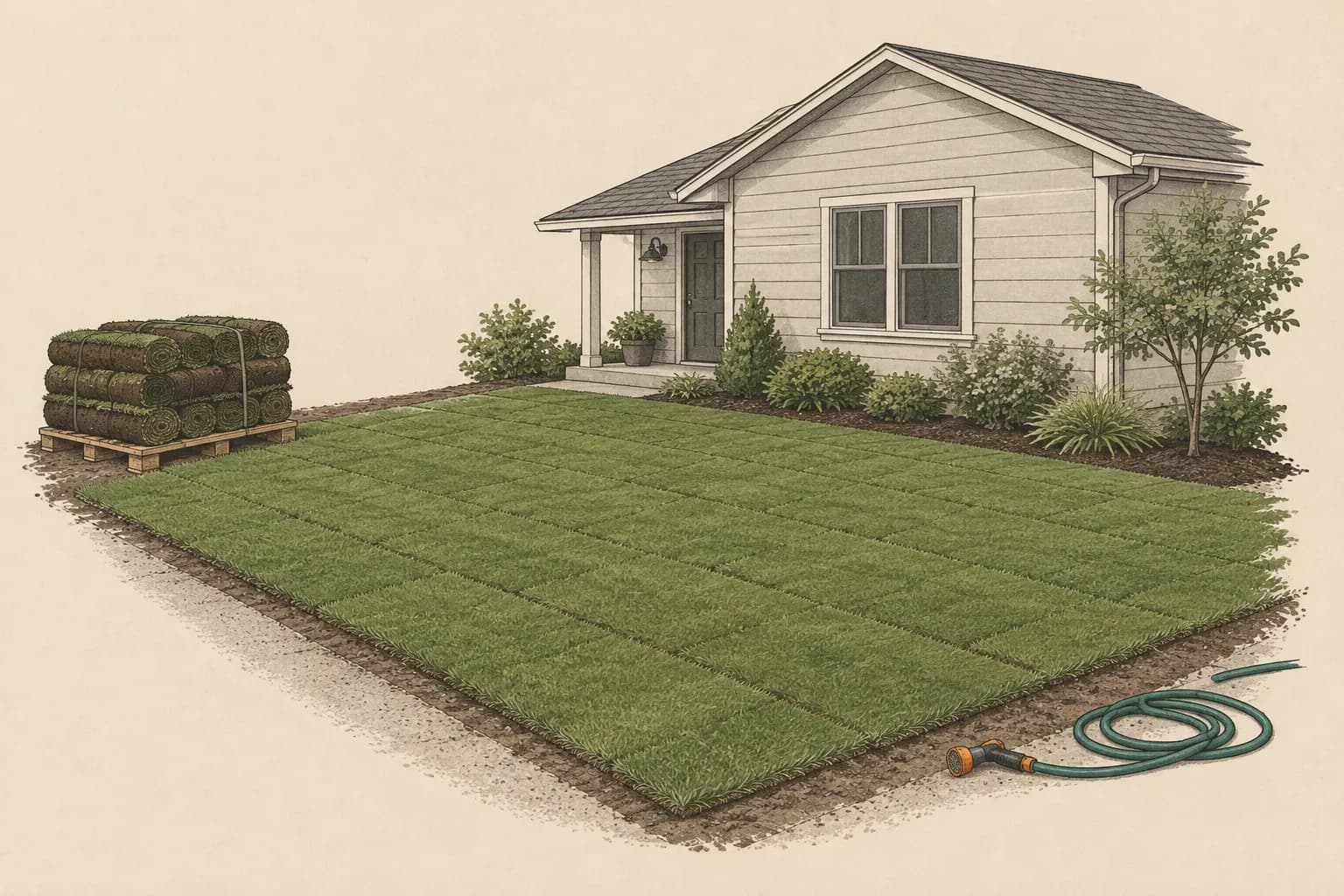
Sod comes in slabs (often 16 x 24 in, about 2.67 sq ft each) or rolls, stacked on pallets that usually cover 400 to 500 sq ft. Farms differ, so ask yours and enter it in the calculator. A pallet weighs roughly 1,500 to 3,000 lb, which is more than many half-ton pickups can carry (1,500 to 2,300 lb).
Sod is perishable. Lay it the day it arrives; pallets heat up and the grass yellows quickly in warm weather.
Prep and leveling soil
Sod roots best into loose, level soil. On poor or bare ground, spread about 4 inches of topsoil; to smooth an existing yard, 1 to 2 inches is often enough. The planner adds the topsoil for whichever depth you choose, with settling built in.
How to measure your lawn
Measure the length and width in feet, multiply for square feet, then decide the depth in inches. For odd shapes, split the area into rectangles, circles, and triangles and add them up; the calculator lets you add as many areas as you need and subtract cut-outs like a tree ring or an air-conditioner pad.
No tape measure? Open the Draw on satellite map tab, find your address, and trace the outline. Or use Pace it off: count steps along each side. Measure depth in a few spots, because ground is rarely flat.
Subtract the house, driveway, patio, and beds as cut-outs.
Want the area on its own first? The lawn size calculator measures any part of your yard and carries it into the other calculators.
When to lay sod
Cool-season sod does best in spring or early fall; warm-season sod in late spring through summer while it is actively growing. Enter your ZIP for your hardiness zone and grass region.
Common mistakes
- Ordering exactly the square footage, with nothing for cuts.
- Letting pallets sit overnight in the sun.
- Not staggering seams.
- Laying on hard, unprepared soil.
Questions people ask
How many square feet are in a pallet of sod?
Usually 400 to 500 sq ft, often about 450. Ask your farm; it varies by grass and cut.
How much sod do I need?
Measure the lawn area, subtract beds and paving, add about 5 percent for cuts, and divide by the pallet coverage. Round up to whole pallets.
How much does a pallet of sod weigh?
Roughly 1,500 to 3,000 lb, heavier when wet. Most half-ton pickups cannot carry a full pallet safely.
How many pieces of sod are on a pallet?
With 16 x 24 in slabs (about 2.67 sq ft), a 450 sq ft pallet holds about 169 pieces.
Do I need topsoil under sod?
On poor or bare soil, about 4 inches helps it root. On decent soil, 1 to 2 inches to level is enough.
When is the best time to lay sod?
Spring or early fall for cool-season grass; late spring through summer for warm-season grass. Enter your ZIP above for your region.
Sources
- Turfgrass Producers International (sod sizes and handling)
- LawnStarter, How Much Does Sod Cost? (national averages, read 2026-10-17)
- Penn State Extension, Lawn Establishment (seeding rates and timing)
- Clemson Cooperative Extension, Home and Garden Information Center, Lawn Establishment
- USDA Agricultural Research Service, 2023 Plant Hardiness Zone Map (data by PRISM Climate Group, Oregon State University)
- PRISM Climate Group, Oregon State University, 2023 USDA Plant Hardiness Zone GIS datasets (ZIP code file)
- NHTSA, Tires: the Tire and Loading Information placard on the driver's door jamb
Last reviewed: . How we calculate
Related calculators and projects
- Sod Installation CostWhat a sod lawn costs with your prices, DIY or installed.
- Grass SeedPounds and bags of seed for a new lawn or overseeding.
- Topsoil CalculatorSoil and dirt in yards, bags, and tons, with settling built in.
- Lawn Size CalculatorMeasure your yard on a satellite map or by pacing it off.
- Compost CalculatorCompost for topdressing a lawn or amending beds.
- Garden Bed RefreshMulch, compost, and edging for every bed in the yard.