Rebar Calculator
Rebar for a slab grid or a footing, counted as the whole sticks you buy, with laps, chairs, and the weight.
Quick answer
A 20 x 20 ft slab with #4 bar at 18 in on center each way, 3 in in from the edges, takes 14 bars each way, 19.5 ft long: 28 sticks of 20 ft rebar with laps, about 374 lb. #4 rebar weighs 0.668 lb per foot.
What are you reinforcing?
Your plans or local code decide
Bars stop this far from the edge
Bar and sticks
40 bar diameters unless your plans say
Each way
28 sticks of #4 (1/2 in).
For a 20 x 20 ft slab
2820 ft sticks
546ft in place
374lb
#4 (1/2 in) · 0 splices with 20 in laps · 14 ft of offcuts
14 bars 19.5 ft long and 14 bars 19.5 ft long, 18 in on center each way, 3 in in from the edges. Pieces are cut from whole sticks, so short offcuts are counted as waste.
HaulOnce order ticket
Rebar order
Ticket no.
083719
Example price, enter yours
Example price
Add a roll of tie wire and a tie tool. A rebar cutter or an angle grinder makes the cuts.
Estimate from haulonce.com. Weights vary with moisture and supplier. Prices are examples unless you entered your own.
Haul Check
Typical 1,150 to 2,400 lb. We use the low end until you enter yours.
Check the Tire and Loading Information sticker on your driver's door jamb for your exact payload.
One trip on weight, with room to spare.
Your 20 ft pieces stick out about 13.5 ft past the closed tailgate.
More than 4 ft out: federal rules require commercial trucks to flag that with a red or orange flag at least 18 in square, and many states require a flag on any vehicle. Check your state, or use a trailer or rack.
Using the low end of the typical payload range. Enter your own for an exact answer.
20 ft sticks and a pickup
What pros know
- The bar number is the diameter in eighths of an inch: #4 is 1/2 in, #5 is 5/8 in. Source
- Keep bars about 3 in from the edges and up off the dirt on chairs. Rebar lying on the ground does nothing once the concrete is poured. Source
- Where two bars meet end to end, overlap them and tie them. About 40 bar diameters is a common lap, 20 in for #4.
- Twenty-foot sticks will not fit in a pickup. Buy 10 ft sticks, have the yard cut them, or ask for delivery.
Pouring the slab too? The concrete slab calculator does the concrete, gravel base, and forms.
Ready to text or email your supplier:
“Rebar: 28 sticks of #4 (1/2 in) x 20 ft, 64 chairs, tie wire for 196 intersections.”
Rebar weight per foot
| Bar | Diameter | lb per ft | 10 ft stick | 20 ft stick | Lap at 40 dia. |
|---|---|---|---|---|---|
| #3 | 0.375 in | 0.376 | 3.8 lb | 7.5 lb | 15 in |
| #4 | 0.5 in | 0.668 | 6.7 lb | 13.4 lb | 20 in |
| #5 | 0.625 in | 1.043 | 10.4 lb | 20.9 lb | 25 in |
| #6 | 0.75 in | 1.502 | 15 lb | 30 lb | 30 in |
| #7 | 0.875 in | 2.044 | 20.4 lb | 40.9 lb | 35 in |
| #8 | 1 in | 2.67 | 26.7 lb | 53.4 lb | 40 in |
How much rebar for a slab
Keep the bars 3 in in from every edge, which is the cover ACI 318 calls for where concrete is cast against the ground. Divide what is left of the width by the spacing and add one for the bars running the long way; do the same with the length for the bars running across. Every bar is the slab size minus the cover at both ends.
Where a bar is longer than a stick, overlap the next one by the lap length and tie them; 40 bar diameters is a common rule, 20 in for #4. The calculator then cuts every piece from whole sticks, so it tells you what to buy, not just the feet of steel.
| Slab | At 12 in | At 18 in | At 24 in | Weight at 18 in |
|---|---|---|---|---|
| 10 x 10 ft | 10 sticks | 7 sticks | 5 sticks | 94 lb |
| 12 x 12 ft | 24 sticks | 16 sticks | 12 sticks | 214 lb |
| 10 x 20 ft | 20 sticks | 14 sticks | 10 sticks | 187 lb |
| 20 x 20 ft | 40 sticks | 28 sticks | 20 sticks | 374 lb |
| 24 x 24 ft | 64 sticks | 43 sticks | 32 sticks | 574 lb |
| 30 x 40 ft | 140 sticks | 94 sticks | 70 sticks | 1,256 lb |
Rebar for footings
Continuous footings usually carry two or three bars running the whole length. Add up every side for the total length and count the corners: each corner gets an L-shaped bar for each run of bar, lapped into both legs. Your plans, or your building department, set the bar size and count.
Chairs and ties
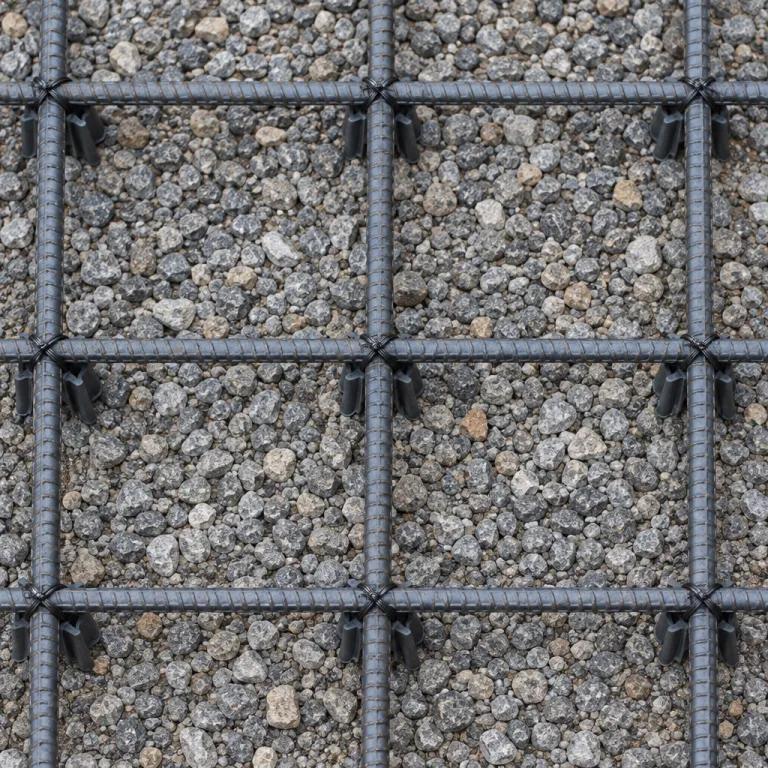
Rebar does its job only when it sits up in the slab, so it rests on chairs or concrete blocks (dobies). A common rule is one about every 3 to 4 ft each way. Tie the bars where they cross, at least every other crossing, so the grid does not shift during the pour. Pouring the slab too? The concrete slab calculator does the concrete and gravel base.
Getting it home
Rebar is not heavy for its size (374 lb for the 20 x 20 slab) but it is long. Twenty-foot sticks stick out far more than 4 ft from any pickup bed. Buy 10 ft sticks (66 of them for the same slab, with more laps), have the yard cut 20s in half, or get them delivered.
What pros know
- The bar number is the diameter in eighths of an inch: #4 is 1/2 in, #5 is 5/8 in. (U.S. standard reinforcing bars (ASTM A615 sizes))
- Keep bars about 3 in from the edges and up off the dirt on chairs. Rebar lying on the ground does nothing once the concrete is poured. (American Concrete Institute)
- Where two bars meet end to end, overlap them and tie them. About 40 bar diameters is a common lap, 20 in for #4.
- Twenty-foot sticks will not fit in a pickup. Buy 10 ft sticks, have the yard cut them, or ask for delivery.
Common mistakes
- Laying the grid on the ground and planning to pull it up during the pour. It rarely ends up in the middle.
- Running bars to the very edge of the form, leaving no concrete cover.
- Counting feet of steel and forgetting the laps and the offcuts from whole sticks.
- Buying 20 ft sticks with no way to carry them.
Questions people ask
How much does #4 rebar weigh per foot?
0.668 lb per foot, so a 20 ft stick is about 13.4 lb. #3 is 0.376 lb per foot and #5 is 1.043.
How much rebar do I need for a 20x20 slab?
At 18 in on center each way, 14 bars each way, 19.5 ft long, which is 28 sticks of 20 ft #4 rebar with laps, about 374 lb.
What is the right rebar spacing for a concrete slab?
Residential slabs commonly use #3 or #4 bar at 18 to 24 in on center each way; driveways and heavier slabs go closer. Your plans or local code decide.
How much should rebar overlap?
A common rule is 40 bar diameters: 15 in for #3, 20 in for #4, and 25 in for #5. Engineered plans may call for more.
How far from the edge should rebar be?
About 3 in. ACI 318 calls for 3 in of cover where concrete is cast against the ground, and the bars should sit up in the slab on chairs, not on the dirt.
Sources
- U.S. standard reinforcing bars (ASTM A615 sizes), as tabulated in the Navy construction manual Table 7-1: nominal diameter and weight per foot
- American Concrete Institute, ACI 318-19 Table 20.6.1.3.1: 3 in of concrete cover for bars in concrete cast against and permanently exposed to earth
- 49 CFR 393.87, Warning flags on projecting loads (red or orange flags at least 18 in square on loads more than 4 ft past the rear of a commercial vehicle)
- NHTSA, Tires: the Tire and Loading Information placard on the driver's door jamb
Last reviewed: . How we calculate
Related calculators and projects
- Concrete Slab CalculatorYards and bags for a slab, plus the gravel base and rebar.
- Concrete CalculatorSlabs, footings, posts, columns, and steps: bags or ready-mix.
- Cinder Block CalculatorBlocks, mortar, and core fill for a wall, with pallets and truck trips.
- Wood DeckJoists, beam, posts, footings, and deck boards from the DCA 6 span tables.
- Linear Feet CalculatorAdd up lengths and convert linear, square, and board feet.
- Gravel CalculatorCubic yards, tons, bags, and truck trips for any gravel.