Asphalt Driveway Calculator
Hot mix tons, the stone base under it, and the dirt that comes out, with a cost estimate from your prices and a check on any quote.
Quick answer
A 50 x 10 ft asphalt driveway built to the common minimum (3 in of asphalt over 4 in of stone base) takes about 9.6 tons of hot mix with 5 percent extra, 8 cubic yards of base stone, and about 13.5 cubic yards of loose dirt to haul away.
Measure
Project details
Sets the minimum thicknesses below. Not sure? Pick poor.
Dug soil takes up about 25% more space (1.25).
Minimums from the Colorado Asphalt Pavement Association for cars and light trucks. Many contractors build thicker; heavy trucks and RVs need more.
Adds local climate notes and goes into your copied order.
9.6 tons of asphalt. 500 sq ft at 3 in compacted, and 13.5 cu yd of dirt to dig out
Your project
9.6 tons of asphalt
500 sq ft at 3 in compacted, and 13.5 cu yd of dirt to dig out
Measured: 500 sq ft, 120 ft of edge
What it costs
Example price, enter yours
Example price, enter yours
Example, enter a local quote
The full price you were quoted
Materials only
$1,515
9.6 tons of hot mix and 8 cu yd of base stone. Labor, equipment, trucking, and dig-out are extra.
Installed by a pro
$3,000
500 sq ft at $6 per sq ft.
These are example prices for you to replace, not quotes for your area. Paving prices change with oil prices, the season, and how far you are from a plant.
HaulOnce order ticket
Asphalt driveway
Ticket no.
737304
- 01Excavation (soil to remove)13.5 cu yd loose
Dig 7 in: 3 in asphalt + 4 in base. 10.8 cu yd in the ground swells to about 13.5 loose.
Plan for a dumpster or a haul-away service. Soil is heavy: many haulers cap dirt by weight or require a dedicated clean-fill container, so tell them it is soil when you book.
- 02Crushed stone base (compacted)7.78 cu yd
4 in deep over 500 sq ft
Order: 8 cu yd bulk (12.4 tons) or 420 bags of 0.5 cu ft. Weighs 21,780 lb to 26,440 lb.
Includes compaction (+20%), waste and uneven ground (+5%).
- 03Hot mix asphalt (compacted)10 tons
3 in over 500 sq ft with 5% extra: 9.3 to 10.1 tons depending on the mix (4.9 cu yd compacted). Shown rounded up to a whole ton.
Before you start
- Slope the surface at least 1/4 inch per foot so water runs off.
- Remove topsoil and roots, then compact the soil before any stone goes down.
- Ask for the compacted thickness of every layer in writing, and compare quotes on the same numbers.
- Call 811 before you dig to have utility lines marked. It is free.
Estimate from haulonce.com. Weights vary with moisture and supplier. Prices are examples unless you entered your own.
Haul Check
Typical 1,150 to 2,400 lb. We use the low end until you enter yours.
Check the Tire and Loading Information sticker on your driver's door jamb for your exact payload.
Crusher run hits your payload long before your bed is full.
That is 22,960 lb over your payload. You need 21 trips.
Split it into 21 loads of about 0.37 cu yd (1,150 lb) each, or get it delivered instead. At this many trips, delivery usually costs less than your time and fuel.
If the crusher run is wet or on the heavy side, plan on 23 trips.
Using the low end of the typical payload range. Enter your own for an exact answer.
What pros know
- Crusher run compacts, so order about 20 percent more than the finished depth. This calculator adds it for you.
Ready to text or email your supplier:
“I need 8 cubic yards of crusher run (dense grade, with fines) delivered.”
Add your ZIP code above to include it.
What goes into an asphalt driveway
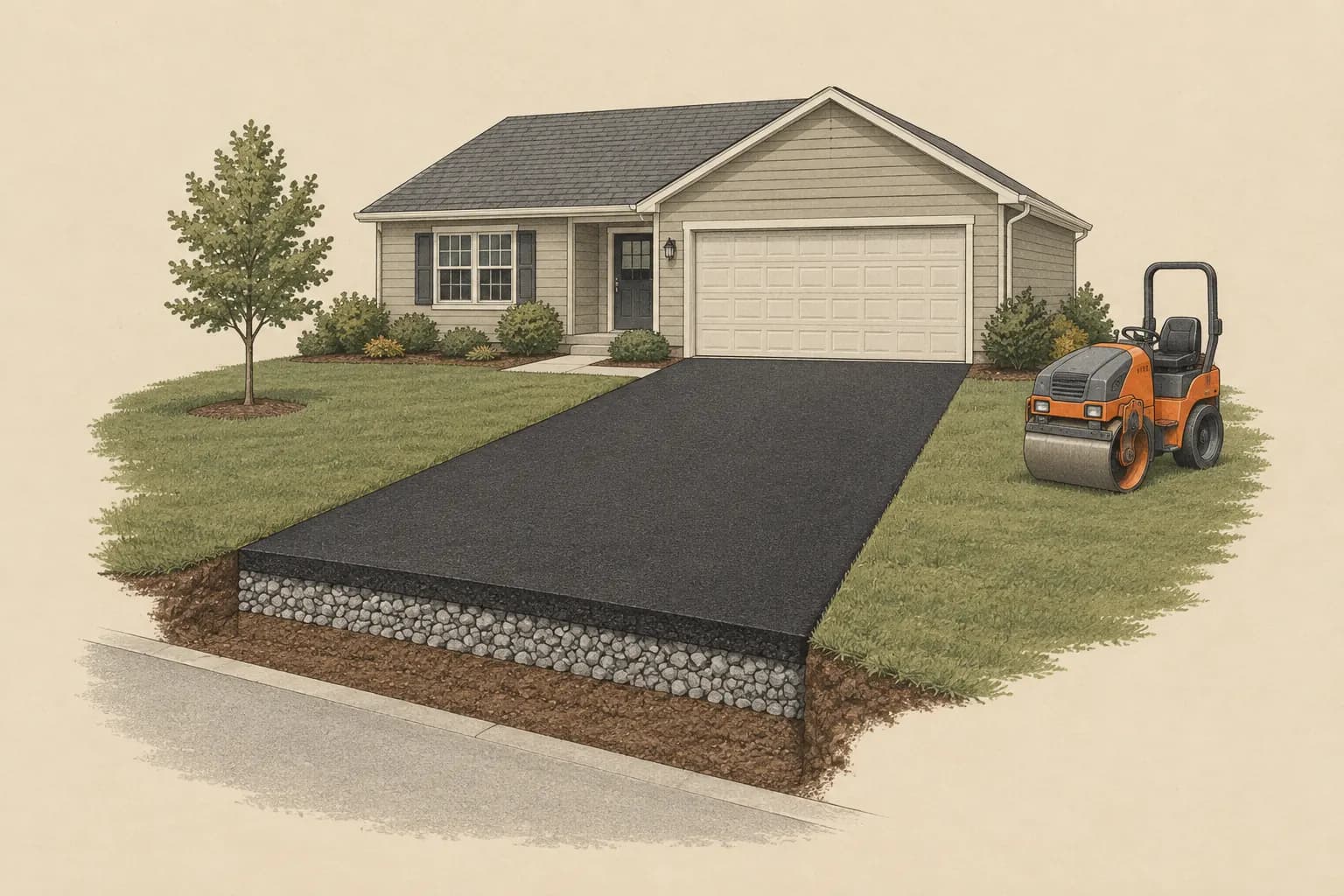
Most home driveways are asphalt over a stone base: the soil is dug out and compacted, a crushed stone base is compacted on top, and hot mix is paved and rolled over it. Full-depth asphalt skips the stone and uses a thicker asphalt section instead. An overlay adds a new layer on an existing driveway that is still sound underneath.
| Soil under the driveway | Full-depth asphalt | Asphalt over base | Stone base |
|---|---|---|---|
| Poor | 5.5 in | 3 in | 6 in |
| Fair | 4.5 in | 3 in | 4 in |
| Good | 4.5 in | 3 in | 4 in |
These minimums from the Colorado Asphalt Pavement Association suit cars, light trucks, and the occasional delivery truck. Many contractors build thicker, and where the ground freezes deep or drains poorly, more base helps. Your ZIP in the planner adds a frost reminder.
What an asphalt driveway costs
The calculator does not guess a national price, because paving prices swing with oil prices, the season, and how far you are from a plant. Instead it builds the cost from your numbers: tons of hot mix times the price per ton, base stone by the yard, and an installed price per square foot from a local quote. All the defaults are examples for you to replace.
The useful part is the quote check. Type in the price you were quoted and it shows the price per square foot and per ton of asphalt, and how much of it is the asphalt itself. The rest is labor, equipment, dig-out, base work, trucking, and profit. When two quotes are far apart, check that both name the same compacted thickness and base depth.
How to measure a driveway
Measure the length along the center and the width in a few places, and use the average. Add the apron at the street, any turnaround, and parking pads as extra areas, or trace the whole thing on the satellite map. Typical widths are about 10 to 12 ft for one car and 16 to 20 ft for two.
The dirt that comes out
A new driveway over base means digging out the asphalt and base thickness: 7 inches for the common minimum, more on poor soil. Soil swells about 25 percent when it is dug, so the pile is bigger than the hole. On a 500 sq ft driveway that is roughly 13.5 cubic yards of loose dirt, which is a dumpster or a haul-away, not a few pickup loads. If you are paving over an old gravel driveway, much of the base may already be there; untick the dig-out to leave it out.
| Material | Low | Typical | High | Tons per yd |
|---|---|---|---|---|
| Crusher run (dense grade, with fines) | 2,800 | 3,100 | 3,400 | 1.55 |
| Paver base (crushed) | 2,800 | 3,000 | 3,200 | 1.5 |
| Asphalt millings (recycled asphalt) | 2,100 | 2,400 | 2,900 | 1.2 |
Pounds per loose cubic yard, as delivered. Wet material sits at or above the high end.
Getting quotes, and the leftover asphalt scam
The Colorado Asphalt Pavement Association puts it plainly: there is no such thing as leftover asphalt. A crew at the door with a truck of “extra” hot mix and a cash price is a well-known scam. Get more than one written quote from contractors you can check, and make sure each one lists the dimensions, the compacted thickness of every layer, the materials, drainage, start and finish dates, and a written warranty.
Thickness is where quotes quietly differ. Going from 2 to 3 inches is 50 percent more asphalt, so two quotes for “a new driveway” can be for very different amounts of material. Put the quote total into the calculator and it shows the price per square foot and per ton, so you can compare them on the same terms.
After it is paved
- New asphalt can be driven on soon after it is placed, but it is best to wait a few days, and keep heavy trucks (like a moving truck) off a fresh driveway.
- Do not seal it until it is several months old, then seal every 2 to 5 years.
- The surface should slope at least 1/4 inch per foot so water runs off.
- Fix potholes and wide cracks early with cold patch. The asphalt calculator counts the bags.
Common mistakes
- Accepting a quote that does not state the compacted thickness of the asphalt and the base.
- Paving over soft soil or topsoil instead of a compacted stone base.
- Building it flat. Without at least 1/4 inch per foot of slope, water sits and gets into the base.
- Forgetting the dig-out. Seven inches of soil from a two-car driveway fills a dumpster quickly.
- Hiring a door-to-door crew with leftover asphalt.
Questions people ask
How much does an asphalt driveway cost?
It depends on local hot mix prices, the size, the thickness, and how much dig-out and base work the site needs. Enter your area, a local price per ton or an installed price per square foot, and the calculator totals it. Prices shown are examples, not local quotes.
How many tons of asphalt do I need for a driveway?
At 3 inches compacted, about 1.83 tons per 100 sq ft. A 50 x 10 ft driveway is about 9.2 tons, plus a little extra for edges and an uneven base.
How thick should an asphalt driveway be?
At least 3 inches of asphalt over 4 inches of compacted stone base on fair or good soil, and over 6 inches of base on poor soil, per the Colorado Asphalt Pavement Association. Full-depth asphalt is 4.5 to 5.5 inches.
How much gravel base goes under an asphalt driveway?
4 to 6 inches of compacted crushed stone, deeper on soft or wet soil. Crushed stone compacts about 20 percent, so the planner orders extra.
How long before I can drive on a new asphalt driveway?
Asphalt can be driven on soon after it is placed, but waiting a few days is better, and heavy trucks should stay off a fresh driveway.
When should I seal a new asphalt driveway?
Not until it is several months old. After that, sealing every 2 to 5 years helps it last and look better.
Sources
- Colorado Asphalt Pavement Association, Technical Brief: Asphalt Driveways (March 2020), minimum thickness designs, drainage, overlays, and homeowner tips
- Tennessee DOT, Design Guidelines 4-307 and 4-411, Tables 4-1 and 4-2 (hot mix asphalt density: 3,816 to 4,140 lb per cubic yard, 106 to 115 lb per square yard per inch)
- Caterpillar, Earthwork Volumes Reference Tables (swell and load factors)
- The Engineering ToolBox, Dirt and Mud: Densities (dry, moist, and wet soils, sand, and gravel)
- NHTSA, Tires: the Tire and Loading Information placard on the driver's door jamb
Last reviewed: . How we calculate
Related calculators and projects
- Asphalt CalculatorTons of hot mix for paving, a quote check, and cold patch bags.
- Asphalt Millings CalculatorRecycled asphalt in tons and yards, with compaction and payload checks.
- Gravel DrivewayThree stone layers plus fabric, as one bill of materials.
- Crusher Run CalculatorCrusher run with compaction already added to the order.
- Concrete Slab CalculatorYards and bags for a slab, plus the gravel base and rebar.
- Paver Base CalculatorCompacted paver base for patios, walks, and driveways.