Fence Calculator
Posts, rails, pickets, and the concrete for every post hole, as one order list with a cost per foot and a truck check.
Quick answer
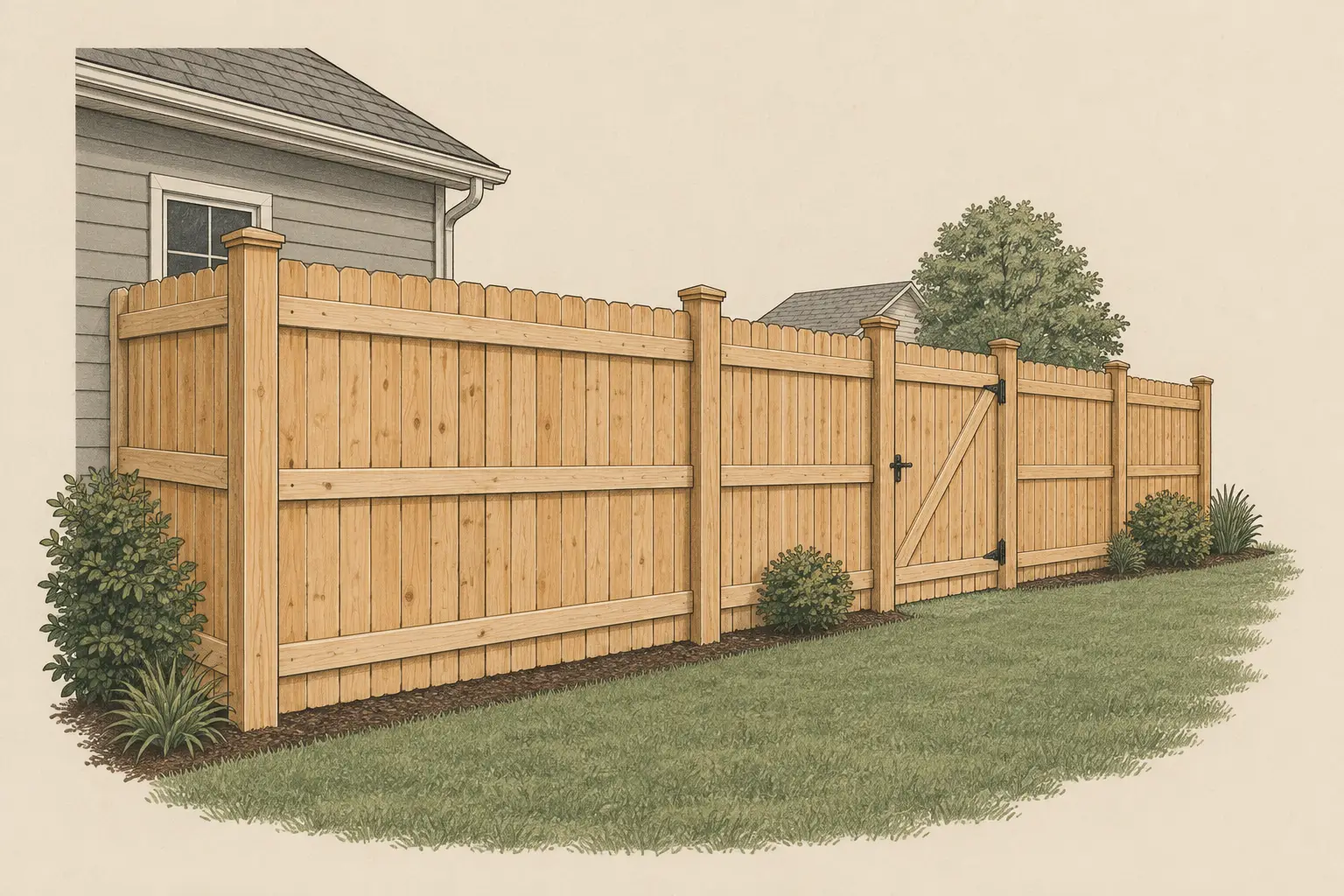
100 ft of 6 ft privacy fence with posts 8 ft apart takes 14 posts (10 ft 4x4s), 39 rails (3 per section), 219 1x6 pickets (230 with 5 percent extra), and about 59 bags of 50 lb concrete, plus a gate post for each gate.
Measure the fence line
A run is a stretch of fence that ends at a post on each side. A fence around three sides of a yard that turns at corners is one run; a fence that stops at the house and starts again is two.
Each adds a post
Fence style
Splits and bad boards
A third of the post length
Adds a frost-depth reminder for your posts.
Wood
Only changes the weight for the truck check.
14 posts, 39 rails, 230 pickets.
For 100 ft of fence
14posts
39rails
230pickets
59 bags of concrete · 10 bags of gravel · about 5,847 lb
13 sections at 8 ft on center. Posts are 10 ft: 6 ft above ground and 3 ft below, rounded up to a stock length. Holes 11 in wide and 42 in deep, including 6 in of gravel, per QUIKRETE.
HaulOnce order ticket
Fence materials
Ticket no.
743105
Example price, enter yours
Example price
Example price
Example price
Example price
Materials only. Add nails or screws, gate hardware, and post caps, and stain if you want it.
Estimate from haulonce.com. Weights vary with moisture and supplier. Prices are examples unless you entered your own.
Haul Check
Typical 1,150 to 2,400 lb. We use the low end until you enter yours.
Check the Tire and Loading Information sticker on your driver's door jamb for your exact payload.
That is 4,697 lb over your payload. Plan on 6 trips of about 975 lb.
At this many trips, ask the yard what delivery costs. It is often less than your time and fuel.
Your 10 ft pieces stick out about 3.5 ft past the closed tailgate.
Drop the tailgate or use a bed extender, strap the load down at two points, and keep the heavy end against the cab.
Using the low end of the typical payload range. Enter your own for an exact answer.
What pros know
- Set each post a third of its length deep, with 6 inches of gravel under it for drainage, and below the frost line where the ground freezes. Source
- Dig holes about 3 times the post width: 10 to 12 inches for a 4x4. Source
- Space posts to match your rails. Eight-foot rails want posts 8 ft on center, so measure center to center, not gap to gap.
- Call 811 a few days before you dig, so buried lines get marked.
Ready to text or email your supplier:
“Fence materials: 14 4x4 x 10 ft posts, 39 2x4 x 8 ft rails, 230 1x6 x 6 ft pickets (Southern yellow pine (loblolly)), 59 bags of 50 lb concrete, 10 bags of gravel.”
Add your ZIP code above to include it.
How the fence is counted
A fence is a row of sections. Divide each run's length by the post spacing and round up for the sections; each run needs one more post than it has sections, and each gate adds a post. Rails are the sections times the rails per section, and pickets are the fence length in inches divided by one picket's actual width plus the gap.
Pickets use the actual width: a 1x6 is 5-1/2 inches wide and a 1x4 is 3-1/2, so 100 ft of tight 1x6 privacy fence takes 219 pickets, not 200. Posts 8 ft on center match 8 ft rails; many builders go to 6 ft for tall fences or windy sites.
How many pickets per section
| Picket and spacing | Per 8 ft section | Per 100 ft |
|---|---|---|
| 1x6, no gap (privacy) | 18 | 219 |
| 1x4, no gap | 28 | 343 |
| 1x6, 2-1/2 in gap | 12 | 150 |
| 1x4, 2-1/2 in gap | 16 | 200 |
| 1x4, 3-1/2 in gap | 14 | 172 |
How deep to set fence posts, and how much concrete
QUIKRETE's guide is to dig the hole about 3 times the post's width and a third of the post's total length deep, plus 6 inches for gravel in the bottom so water drains away from the post. For a 6 ft fence that is 3 ft in the ground, so a 9 ft post; the calculator rounds up to a stock 10 ft post. Where the ground freezes, go below the frost line. Your ZIP adds a reminder.
| Post and depth | Hole | 50 lb bags | 80 lb bags |
|---|---|---|---|
| 4x4, 2 ft deep | 11 in | 2.6 | 1.6 |
| 4x4, 2.5 ft deep | 11 in | 3.4 | 2.1 |
| 4x4, 3 ft deep | 11 in | 4.2 | 2.6 |
| 6x6, 3 ft deep | 17 in | 9.9 | 6.2 |
| 6x6, 4 ft deep | 17 in | 13.5 | 8.4 |
For a single post, the concrete calculator has a post hole option with round posts too.
What a wood fence costs
Lumber prices move too much to print one national number. Enter your prices for a post, a rail, a picket, and a bag of concrete, and the ticket totals the materials and works out the cost per foot of fence. The defaults are examples only. Labor, gate hardware, fasteners, and stain are extra, so a contractor's quote per foot will be higher than the materials alone.
Getting it home
A fence order is heavy and long. 100 ft of 6 ft privacy fence is about 5,800 lb of dry lumber, concrete, and gravel, more than a half-ton's 1,150 lb payload. Fresh pressure-treated lumber weighs much more: a wet 4x4 x 10 ft post is about 52 lb.
Ten-foot posts stick out about 3.5 ft from a 6.5 ft bed, and 16 ft rails would stick out more than 4 ft, which on a commercial vehicle means a red or orange flag at least 18 inches square, and many states require one on any vehicle. The calculator checks both, and the board foot calculator weighs any other lumber list.
What pros know
- Set each post a third of its length deep, with 6 inches of gravel under it for drainage, and below the frost line where the ground freezes. (QUIKRETE)
- Dig holes about 3 times the post width: 10 to 12 inches for a 4x4. (QUIKRETE)
- Space posts to match your rails. Eight-foot rails want posts 8 ft on center, so measure center to center, not gap to gap.
- Call 811 a few days before you dig, so buried lines get marked.
Common mistakes
- Counting pickets on the nominal width. A 1x6 covers 5-1/2 inches, so you need about 9 percent more than 2 per foot suggests.
- Forgetting the extra post at every gate and at the end of every run.
- Setting posts too shallow. A third of the post's length goes in the ground, deeper where it freezes.
- Filling the post hole to the top with concrete. Stop a few inches below grade and slope it so water runs off.
- Digging before calling 811 to mark buried lines.
Questions people ask
How many fence posts do I need for 100 feet?
14 posts at 8 ft on center for one straight run, plus one more for each gate. At 6 ft spacing it is 18.
How many pickets do I need for 100 feet of fence?
219 1x6 pickets for a privacy fence with no gaps, or 200 1x4 pickets with 2-1/2 in gaps. Add about 5 percent for split or warped boards.
How far apart should fence posts be?
Most wood fences use 8 ft on center, to match 8 ft rails. Use 6 ft for tall fences, heavy gates, or windy sites. Measure center to center.
How deep should fence posts be?
QUIKRETE recommends a third of the post's total length, plus 6 inches of gravel underneath. For a 6 ft fence that is 3 ft deep, and below the frost line where the ground freezes.
How much concrete do I need per fence post?
For a 4x4 in an 11 in hole 3 ft deep, about 4.2 bags of 50 lb concrete. Shallower holes take less; the table above has more sizes.
How many rails does a 6 foot fence need?
Three 2x4 rails per section is the common choice for a 6 ft fence (top, middle, and bottom); 4 ft and shorter fences usually use two.
Sources
- QUIKRETE, Setting Posts project guide (hole 3 times the post width, depth 1/3 of post length plus 6 in of gravel)
- QUIKRETE, Fast-Setting Concrete Mix spec data sheet (post setting yields)
- USDA Forest Products Laboratory, Wood Handbook: Wood as an Engineering Material (FPL-GTR-282, 2021): Table 5-3a specific gravity, Table 4-6b density by moisture content, Table 6-4 hardwood thicknesses, Table 6-6 American Standard lumber sizes, and the glossary definition of a board foot
- 49 CFR 393.87, Warning flags on projecting loads (red or orange flags at least 18 in square on loads more than 4 ft past the rear of a commercial vehicle)
- NHTSA, Tires: the Tire and Loading Information placard on the driver's door jamb
Last reviewed: . How we calculate
Related calculators and projects
- Board Foot CalculatorBoard feet, price, and weight for a lumber list, plus a truck check.
- Concrete CalculatorSlabs, footings, posts, columns, and steps: bags or ready-mix.
- Cinder Block CalculatorBlocks, mortar, and core fill for a wall, with pallets and truck trips.
- Gravel CalculatorCubic yards, tons, bags, and truck trips for any gravel.
- Lawn Size CalculatorMeasure your yard on a satellite map or by pacing it off.
- Paver PatioPavers by pattern, base, sand, edging, and the dirt you dig out.